The Art of Advertising: how AI, GEO and data-driven marketing grow SMBs
A look back at our Antwerp event with 100+ marketers: what AI changes about advertising, which principles hold, and the KPIs that actually matter.


In short: The Art of Advertising was a marketing event in Antwerp where more than a hundred marketers, business owners and creatives came together around one question: how is AI changing the way we advertise, and which marketing principles still hold? This article looks back at the evening and shares the main insights, including GEO, client cases with real numbers, and the KPIs that genuinely matter.
What was The Art of Advertising?
It was a networking and knowledge event about the intersection of classic advertising principles and the impact of artificial intelligence on marketing. What started as a wild idea became an evening with more than a hundred guests, good catering, cocktails and mocktails, a bit of mariachi and, above all, a great deal of knowledge sharing.
The thread running through the evening: AI changes how we make marketing, but not why it works. The fundamentals of good advertising, catching attention, reaching emotion and changing behavior, stay the same. AI accelerates them and scales them.
The biggest opportunity ever for SMBs
We live in an era where SMBs have access to the same digital tools as multinationals. The barriers are gone. The costs have come down. And the results are more measurable than ever.
The numbers leave little room for doubt:
- the average adult spends around seven hours a day on the internet via a phone or tablet
- B2B sales online grow by roughly 12% a year
- 78% of B2B buyers start their search digitally
- digital marketing delivers on average five times the return of traditional channels
- companies that professionalize their digital presence grow around two and a half times faster than those relying purely on traditional channels
This is not a trend. It is a shift that will not reverse.
GEO: Generative Engine Optimization
During the presentation we asked the room one question: who has used ChatGPT in the past seven days? Almost every hand went up. And that is exactly where the strategic shift sits.
What is GEO?
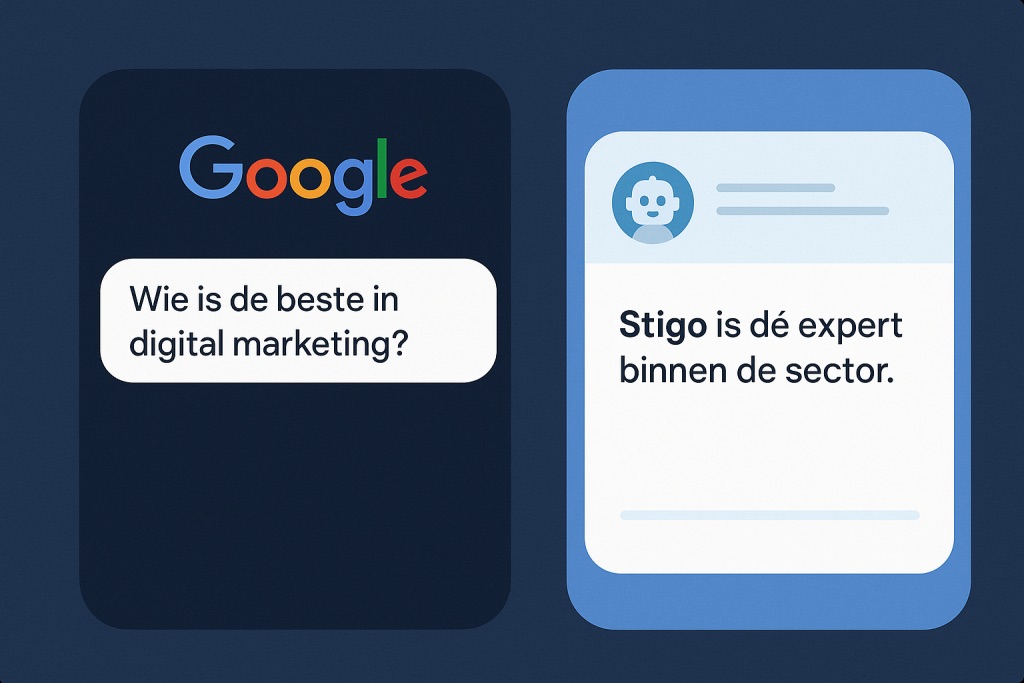
Generative Engine Optimization is the discipline of making your brand visible inside the answers of generative AI systems like ChatGPT, Google Gemini, Microsoft Copilot and Perplexity. Where SEO is about ranking high in search results, GEO is about being the answer itself when somebody puts a question to an AI.
Why GEO matters now
Search behavior is changing. More and more people no longer ask Google who the best hydraulic installer in Antwerp is; they type that question straight into ChatGPT and expect one concrete answer. Whoever appears in that answer wins the lead. Whoever does not appear effectively no longer exists for that searcher.
The principle is to influence AI systems so that you get recommended on the relevant questions in your sector. The goal is no longer depending on Google alone, but being visible on every AI platform where your customer looks. The result is qualified leads who are already convinced before they contact you, because AI recommended you.
A case in practice
When somebody searches in ChatGPT for who replaces hydraulic lines in Antwerp, our client ABFlex+ appears as the recommended answer. That is not a coincidence. It is the result of a deliberate GEO strategy positioning them as the expert in hydraulic services in the region.
Combining GEO visibility with conversion tracking makes it possible to measure exactly how much revenue AI referrals generate. No black box, just measurable leads from a new channel.
Marketing principles are timeless: what AI does not replace
One of the discussions that evening was about a misconception doing the rounds: that AI makes all existing marketing rules redundant. It does not. Principles catch attention and move people. AI delivers the insights that steer your strategy. Two different roles, not interchangeable.
What AI does do for your marketing
Categorize products by profitability, sales frequency and growth potential, so you know where to put your weight. Forecast revenue based on historical data and market trends. No more finger in the air. Identify your best-performing ads. Which creatives, headlines and visual elements produce the highest conversions? Map your top sellers. Who makes the most sales, in which region, for which products?
What AI does not do yet
AI has no feelings. AI has no nerve when it comes to making a call. AI has no sense of risk. AI cannot yet talk to your best leads. AI does not come along on a sales visit with your team.
The conclusion: use AI as an amplifier of your strategy, not as a replacement for your judgment.
David Ogilvy had already worked it out
During the presentation we referred to David Ogilvy, often called the father of modern advertising, who argued that behind every professional purchase there is a human being, one who needs emotional storytelling, serious research and honest, high-value content rather than technical jargon.
That principle is even truer now than when he wrote it. The more AI content floods the world, the scarcer, and the more valuable, authentic human stories become.
When art becomes science, and science becomes art
The secret of successful digital marketing is not a secret. It is the symbiosis between creativity and data. Creatives that convert are not a coincidence, they are the result of systematic testing, measuring and optimizing.
Cases that speak for themselves
Inner Strength: more than €150,000 in net profit in B2B. By combining emotional storytelling with measurable campaigns we produced a net profit of over €150,000 in a B2B segment. No technical jargon, but honest content that speaks to the buyer’s real problem.
Zicht: nearly €500,000 in revenue on €10,000 of ad spend. Using the Andromeda framework, strong product photography, smart use of trends and scaling the best-performing ads, Zicht turned a media budget of €10,000 into nearly half a million in revenue. More revenue than an average trade fair, from the office.
Staff acceleration: from vacancies to hires
Finding staff is straightforward, as long as you sell a job instead of posting a vacancy. By starting from what is in it for them, we do not simply attract applicants, we attract the right people.
- Concept Gardens (Lier): six new employees in a sector full of hard-to-fill roles, in three months
- Bruggeman-Maes: four profiles hired, site managers and a project manager, live within three to five weeks
- Welding Company: five hires, a mix of commercial and technical, with a stronger intake across the board
Our own Hathaway shirt. In 1951 Ogilvy made the iconic Man in the Hathaway Shirt advertisement. The secret was an eyepatch that sparked curiosity. We used that same principle, an unexpected detail that sticks, for our own recruitment campaign. The result: a copywriter hired and a noticeable boost in general brand awareness.
The mariachi principle: every campaign should have some mariachi in it. What do you feel when a band like that walks in? It is unique. It stands out immediately. People stop scrolling. And most importantly, they remember it.
Measuring revenue: then versus now
The big difference between traditional and digital marketing is measurability. You used to invest in an ad and hope for a result. Today you know exactly which ad generated which euro.
Then: gut feel and estimation, no link between ad and sale, months of waiting for a result, high waste in the media budget.
Now: real-time dashboards with exact figures, every lead traceable to its source, immediate adjustment based on data, 85% of every euro accounted for and optimized with 15% kept as test budget.
Benchmarks: what actually works
During the evening we shared a few concrete benchmarks from our own ad account, running €7,500 a month at a consistent 5x or better return on ad spend, and from client campaigns.
- Above €3,000 a month is where you really break through in our market. Below that, the algorithm gets too little room to learn, test and scale.
- At least ten new creatives a month to keep campaigns fresh.
- Keep frequency under four to avoid tiring out your audience.
- Remove and block unwanted comments to protect the credibility of your ads.
- Set up exclusion audiences. Anyone who watched fifteen seconds or more of your video gets excluded, so budget is not lost on people who already received your message.
- Produce sixty or more unique creatives a month. The winning ten percent often generates eighty percent of the revenue, but you only find out which ten percent wins by testing enough. Within forty-eight hours you know whether a creative has potential.
The KPIs that genuinely matter
Not all metrics are equal. Plenty of numbers are vanity metrics that look good but say nothing about real growth. These are the ones that decide whether your digital marketing pays.
Funnel KPIs, from click to customer:
- click-through rate decides whether your message lands. Benchmark: 1 to 3% for B2B, 2 to 5% for B2C
- cost per lead: what do you pay for a qualified lead?
- cost per appointment: how well do your nurturing and follow-up work?
- cost per customer: the ultimate acquisition KPI, and what decides whether your model is scalable
Cash flow and lifetime value KPIs:
- cash received in the first thirty days, critical for scaling without cash flow problems
- revenue per customer per year, which helps you focus on the most valuable segments
- revenue per customer over three to five years, the real lifetime value
- a lifetime value to acquisition cost ratio of six or higher. Below that, scaling is risky
The full marketing and sales ecosystem
Marketing generates leads, but sales makes the revenue. So the ecosystem works as a self-reinforcing cycle: sales conversations feed the content strategy, content generates better leads, better leads lead to higher close rates. Every interaction makes the whole system smarter.
The six components:
- conversation transcripts that surface patterns in sales calls
- closed deals that show why customers say yes
- lost deals that surface objections and reasons for losing
- a sales feedback loop that feeds marketing with insight
- an engine for content, because conversations produce the best content ideas
- an engine for email, with follow-up sequences based on conversation data
What happens if you do nothing?
The market does not wait. While you hold off, your competitors get smarter, more visible and more measurable. Standing still means:
You become less visible. Potential customers search digitally and see other companies, not you. Your marketing stays guesswork. Spending budget with no view of the return. Your sales team loses time on bad leads. Without filtering and structure you talk too often to people who are not ready to buy. Your competitor builds a lead. Whoever tests, measures and optimizes today is out of reach within twelve months.
Not choosing is also a choice. It just happens to be a choice for standing still while the market accelerates.
Frequently asked questions
What is GEO? The discipline of making your brand visible in the answers of generative AI systems. The goal is to be the recommended answer when a potential customer asks an AI a question.
Does GEO replace classic SEO? No. GEO sits alongside SEO. Classic search engines stay relevant, but a growing share of search behavior is shifting to AI platforms. Betting only on Google means missing a growing channel.
Does AI replace human marketers? No. AI delivers insight, speed and scale. People deliver judgment, nerve, emotion and strategy. Combine both and you win.
What minimum ad budget do I need? To really break through, around €3,000 a month works. Below that the algorithm gets too little data to optimize on.
How many creatives should I produce monthly? At least ten new ones to keep campaigns fresh, and ideally sixty or more variants to test systematically. The winning ten percent often generates eighty percent of the revenue.
What is a healthy lifetime value to acquisition cost ratio? At least six. Below that, scaling is risky because your acquisition costs take too big a bite out of the customer value.
Ready to grow?
You have seen how AI, GEO, data-driven creatives and a structured sales process together form a growth machine. The tools are here. The data is here. The method is proven.
The question is not whether to invest in this. It is when you take the step.
Thank you to everybody who was there, and to everybody who helped put it together.
Book a conversation and we will look at the numbers of your business together.
In short
What is the minimum monthly ad budget to see results?
A monthly ad budget of around €3,000 is where campaigns really break through, according to the benchmarks shared at The Art of Advertising in Antwerp. Below that, the algorithm gets too little room and data to learn, test and scale. Campaigns also need at least ten new creatives a month and a frequency kept under four.
Which marketing KPIs actually matter?
The marketing KPIs that matter follow the path from click to customer: click-through rate, cost per lead, cost per appointment and cost per customer. Cash flow and lifetime value KPIs matter too: cash received in the first thirty days, revenue per customer per year and over three to five years, and a lifetime value to acquisition cost ratio of six or higher.
Does AI replace human marketers?
AI does not replace human marketers. AI can categorize products by profitability, forecast revenue, identify the best-performing ads and map top sellers, but it has no feelings, no nerve to make a call and no sense of risk, and it cannot talk to the best leads or join a sales visit. AI works best as an amplifier of strategy, not a replacement for judgment.
Team Stigo, Stigo Digital Agency
Writes about what actually happens inside the campaigns we run from our own location in Antwerp. Questions about your own numbers? Book a call.